Your product does not need another rewrite. It needs the right modernization — targeted at the architecture, API, data and delivery constraints holding the platform back, while revenue-critical paths stay online.
Focused modernization workstreams that reduce risk and unlock the next phase of product evolution — without stopping the business.
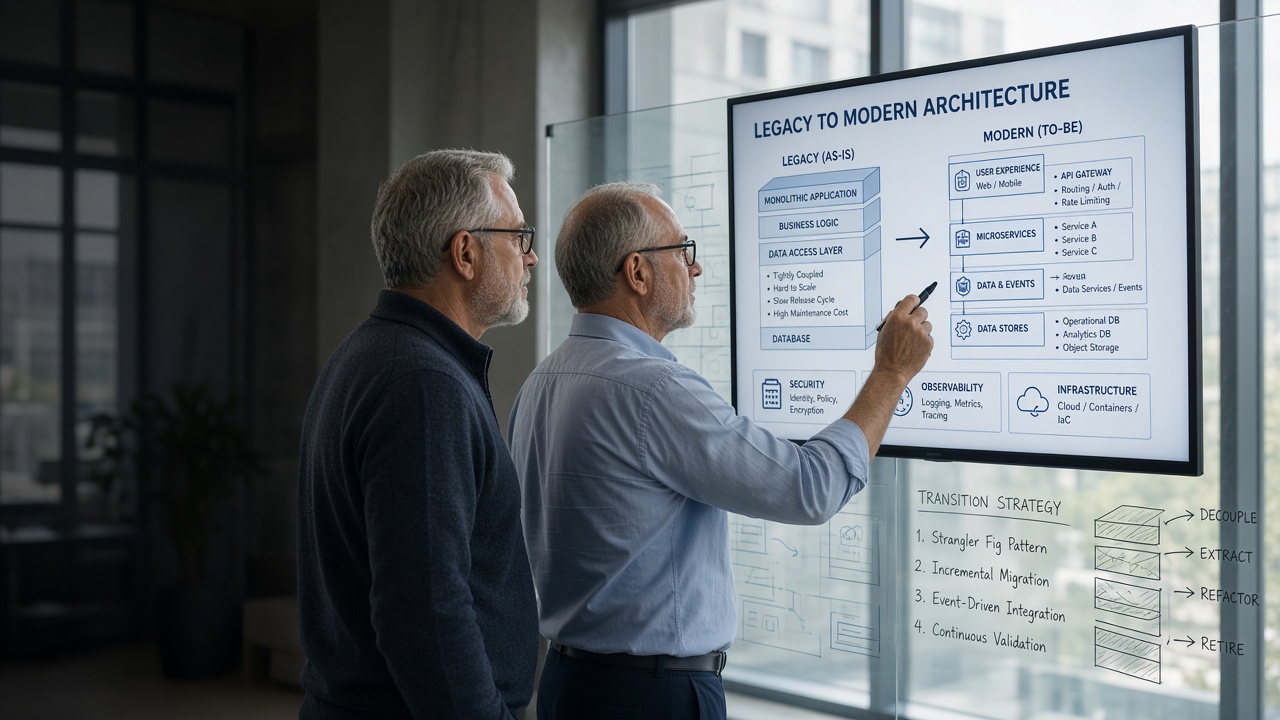
Clarify domain seams, reduce coupling and introduce service or module boundaries where the monolith or tangle is slowing change.
Stabilize contracts, modernize partner and internal integrations, and introduce event patterns where synchronous sprawl is the bottleneck.
Database and storage modernization, cloud migration paths, CI/CD and observability so delivery and operations can keep pace with product demand.
Clean data access, retrieval paths and workflow hooks so copilots and agents can attach to real product surfaces later — without a greenfield detour.
Modernization is sequenced against business risk — we change what constrains growth first, with a path that stays operable throughout.
Assess architecture, integrations, data stores, delivery friction and the product outcomes that are blocked today.
Prioritize modernization targets, migration slices and compatibility strategies so change is incremental and reversible where needed.
Execute architecture, API, data, frontend or cloud workstreams in production-safe increments with clear rollback and cutover plans.
Harden observability, CI/CD and operational practices so the modernized platform stays shippable and ready for the next capability wave.
Choose targeted modernization when the product is valuable — and the architecture, not the idea, is what is holding it back.
Modernization often pairs with new product work, AI embedding, cloud platforms and industry-specific systems.
How we approach evolving successful products without betting everything on a rewrite.
Rarely as a default. We prefer targeted modernization of the constraints that block growth — architecture seams, APIs, data and delivery — while preserving domains that already work in production.
We map business outcomes to technical bottlenecks: release risk, integration fragility, data limitations and operational blind spots. Priority goes to changes that unlock the next product capabilities with acceptable cutover risk.
Yes. Work is sequenced in production-safe increments with compatibility layers, dual-run windows and rollback plans so revenue and operations paths continue during the transition.
It means preparing data access, retrieval and workflow attachment points so copilots and agents can plug into existing product surfaces later — without requiring a separate greenfield system.
When the experience layer is a constraint — outdated patterns, operator friction or tight coupling to legacy backends — frontend modernization is part of the same sequenced program.
Cloud migration, CI/CD and observability often unlock modernization velocity. When those gaps are material, we address them alongside architecture and API work — or via our cloud platform engineering practice.
Organized by engineering layer — technology supports product outcomes, not the other way around.
Product modernization
Targeted architecture, API, data and platform change that keeps the product shipping.
Request a Modernization Assessment